
Southern Regional Jail Release Paths
Southern Regional Jail and Correctional Facility, often shortened to SRJCF, is the state-run regional jail that serves Summers County. A person held before trial may go back to the community after bond, recognizance, or another court order. Recognizance means release based on a promise to return to court rather than payment of a secured bond. The criminal case may continue after the person leaves. A Summers County magistrate or circuit order explains the legal basis, while the DCR release transaction shows when facility staff ended that custody episode.
Not every exit leads home. A sentenced person may move from the regional-jail side of DCR to a state correctional institution. Another person may be handed to a different county, federal authority, or another agency under a detainer. A detainer is a request or process that can keep custody going after the first case permits release. A transfer ends custody at SRJCF but is not freedom. The destination or movement code in the DCR record is essential when a name disappears from the active jail search.
Confirm a Southern Regional Release
Begin with the official Regional Jail Offender Search. Search the person's name and compare the available identity, facility, charge, and county details. A matching active result at SRJCF supports present reported custody, subject to system lag. If the result is gone, do not assign a release date from the time of that search.
- Save the full name, OIS or booking number, Summers case number, and the time of the search.
- Check the prison search linked from the WVDCR gateway for an internal move to state custody.
- Use the official magistrate search and the Summers Circuit Clerk for the newest bond, dismissal, or sentencing order.
- Review VINE status and notices, remembering that transfer notice waits until arrival at the receiving facility.
- Request the admission, release, or movement transaction from DCR when the public sources conflict or no longer show the record.
The court and facility records answer separate questions. An entered release order gives the authority. It may precede physical discharge, and another hold may block a return to the community. The DCR transaction identifies the custody exit and its recorded type. The broader Summers County released-inmate search and records path explains how to align those sources for one named person.
Note: Record a negative search only as no active match found at that time, never as proof of a release time.
Southern Regional Jail Release Records
WVDCR operates SRJCF, so DCR is the main custodian for the regional-jail booking, photograph, and custody-exit transaction. The Summers County Sheriff's Office holds its own arrest or incident material, not the state facility's release record. The appropriate court clerk holds the bond, dismissal, sentencing, or commitment order. Ask each office only for the record it created or maintains.
A focused written request should name one custody episode. Include the person's full name, known date of birth, OIS or booking number, approximate admission and exit range, SRJCF, and Summers County case number. Ask for admission date and time, release or transfer date and time, exit type, release authority, public destination category, the Order of Release, and any releasable booking photograph. If the response uses an administrative code, ask for the code legend in effect on the transaction date.
| Record | What it can confirm | Custodian |
|---|---|---|
| Release or movement transaction | Exit time, type, facility, and recorded destination | WVDCR |
| Bond or release order | Legal authority for release on the Summers case | Magistrate or Circuit Clerk |
| Arrest or incident report | Local encounter and arresting authority | Summers County Sheriff |
| VINE notice | Reported custody-status change | VINE, then verify with DCR |
West Virginia FOIA requires a reasonably specific request to the records custodian. Under section 29B-1-3, the agency must respond as soon as practicable and within five business days, excluding weekends and legal holidays, by producing records, arranging inspection, or denying in writing. That is a response deadline, not a promise that every large production will finish in five days. Request redaction and release of the reasonably segregable public parts when protected details share the file.
Southern Regional Jail Contact
Facility staff can answer current operational questions, though public information may be limited by privacy, safety, and security rules. A telephone answer is useful for a prompt check, but a written DCR record is stronger when the precise exit time, authority, or destination matters. The facility is in Beaver, Raleigh County, rather than in Summers County.
1200 Airport Road
Beaver, WV 25813
Phone: 304-256-6726
Fax: 304-256-6739
For a written offender-record request, contact WVDCR at 1409 Greenbrier Street, Charleston, WV 25311. DCR policy calls for a written request addressed to the Commissioner as records custodian and a clear description of what is sought. Confirm the current delivery method before sending private identifiers.
Southern Regional Jail History
SRJCF was built in 1994. WVDCR identifies Fayette, Greenbrier, Mercer, Monroe, Raleigh, Summers, and Wyoming as the seven counties it serves. Its FY2025 rated population was 468. These details explain why a broad request for all Southern Regional Jail releases would not isolate Summers County. A sound request filters by committing or charging county and a defined date range.
The same annual report says SRJCF contractually houses U.S. Marshals Service detainees. Physical location alone therefore does not identify which government has release authority. A state pretrial booking, a DCR sentence, and a federal USMS hold may share a building while following different records systems. The case number and committing authority decide whether DCR, a Summers court, USMS, or BOP supplies the controlling release evidence.
The official facility page provides a useful visual check of the address and service area. View the WVDCR SRJCF facility page before relying on contact details.
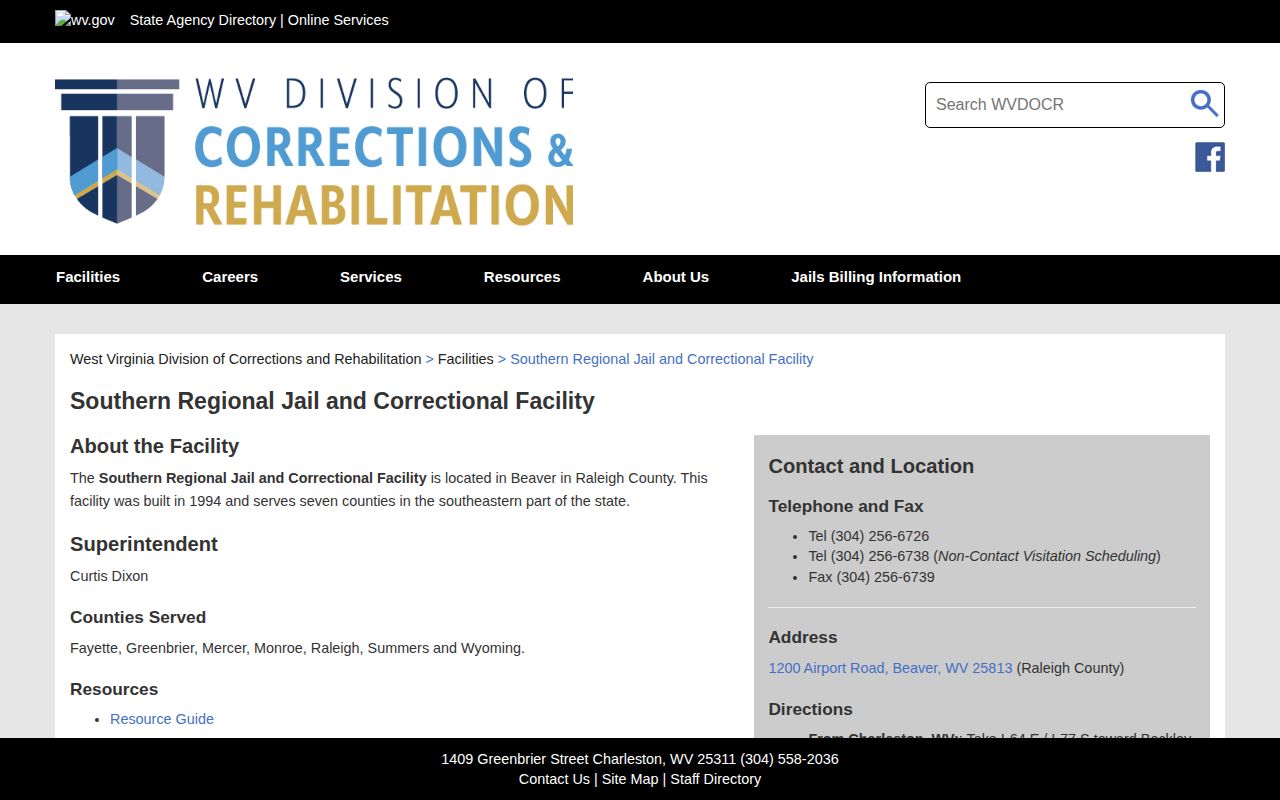
The captured official page anchors this Summers County release route to the state-operated facility in Beaver, not to a nonexistent county jail roster.
Southern Regional Parole Releases
A parole grant for someone at a regional jail is not an immediate gate release. Parole lets an eligible person serve the remaining sentence in the community under conditions, but the West Virginia Parole Board says a regional-jail grantee first transfers to a DCR facility for intake and fingerprinting. Its FAQ advises anticipating seven to ten days before actual release. Conditions such as an approved home plan may also remain.
Check the written Board outcome, then follow DCR custody. A grant can be rescinded before release, and a transfer in the state system may replace the SRJCF result. After physical departure, DCR Parole Services handles supervision. The Board decides release, but DCR holds the movement and actual custody-exit data. PED, the parole eligibility date, is only eligibility for consideration and must never be presented as the day someone will walk out.
Southern Regional Federal Custody
A federal pretrial detainee housed under the USMS contract may not appear in the public BOP locator. USMS can move pretrial prisoners among contract facilities, and the federal docket may contain the detention or release order. After a federal sentence and BOP designation, the BOP locator becomes more useful. A disappearance from West Virginia OIS can mean federal movement, not a release.
Identify the sovereign from the case number and court. Use the U.S. District Court record and USMS Prisoner Operations for a pretrial federal case. Use the BOP locator after designation. If the BOP result says “Released” or “Not in BOP Custody,” it addresses BOP custody only. Another authority or a term of federal supervised release may follow.
Note: The custodian, case, and exit record matter more than the building when state and federal detainees share SRJCF.
Southern Regional Release Terms
Several labels help keep the record straight. “Transfer” means custody continued elsewhere. “Discharge” means the identified custodial or supervision obligation ended. “Parole” is conditional community release while the sentence continues. “Time served” is a court sentence description, not the precise physical exit timestamp. Each term should be tied to the source that used it.
- Release authority
- The court order, Board action, sentence calculation, or other legal basis for an exit.
- Exit type
- The DCR category that describes release, transfer, parole, discharge, or another movement.
- Detainer
- Process from another authority that may continue custody after the first matter allows release.
- Final discharge
- The recorded end of the identified sentence or supervision phase, subject to other cases or duties.
Keep each booking distinct. A later warrant, revocation, or new charge can create a new custody episode and booking number. The old release remains an event in the prior record even if the person returns to custody.