
Summers Release Dates Defined
Four dates can appear in a Summers County custody history. The court sentence and jail credit are inputs. A parole eligibility date, usually shortened to PED, marks when a person may first qualify for Board consideration under the applicable law. DCR's minimum discharge date or final release date is the scheduled end after the agency applies sentence data and eligible credits. The actual date and time record when a custodian completed an exit transaction.
Those dates answer different questions. PED does not promise an interview, grant, or departure. Minimum discharge remains projected and may change. An actual exit from Southern Regional Jail ends that facility's custody episode but could be a transfer to a prison, federal authority, or another agency rather than return to the community.
| Date | Meaning | Proof of release? |
|---|---|---|
| Sentence start and jail credit | Court inputs used in the DCR computation | No |
| PED | First point for parole consideration under the applicable rule | No |
| Minimum discharge or final release | DCR's scheduled endpoint after applicable credit | Projected only |
| Actual release date and time | The physical custody-exit transaction | Yes for that custodian, though it may record a handoff |
Find a Summers Projected Date
The search path depends on why the person is held. For a Summers County pretrial case at Southern Regional Jail and Correctional Facility, use the court docket to find the latest bond or detention order. There may be no fixed date at all. For a sentenced state prisoner, start with the WVDCR offender-search gateway, choose the prison search, and compare the person, OIS number, institution, and Summers sentencing information.
Official research did not establish a stable public list of all projected-release fields for every record. Record the exact label displayed on the live official result. If no date appears, or the label is unclear, ask DCR Records for the minimum-discharge computation or public sentence-calculation material. Do not import a date from a third-party page.
- Identify the custody type: pretrial regional jail, county sentence, state sentence, or federal custody.
- Match the full name with the OIS number, case number, facility, and sentencing county.
- For a state sentence, use the prison channel from WVDCR and record the exact date label shown.
- For a local case, obtain the entered Summers County order and ask DCR about the custody computation.
- Request the individual timesheet or release transaction when the public screen is missing, unclear, or out of date.
- Confirm the actual exit with DCR, the court, or the receiving custodian.
A short Summers County sentence and a state prison sentence can use different records even when both pass through SRJCF. For a local sentence, the entered order states the term and jail credit, while DCR records the regional-jail computation and exit. A sentenced felon transferred into the prison system should be checked through the prison search. Movement from the jail result to the prison result is continued custody, not release.
Federal custody has another timeline. SRJCF contractually houses some U.S. Marshals Service detainees, but a pretrial USMS detainee may not appear in the public BOP locator. Use the federal docket and USMS for that stage. After designation to a federal sentence, use BOP. Do not apply West Virginia good-time rules to a federal term.
The broader Summers County released inmates search path explains how to compare the jail result, prison result, and court disposition after a name disappears.
Note: A pretrial Summers County detainee has no computed sentence endpoint unless and until a sentence or release order supplies one.
Summers Good-Time Release Computation
West Virginia Code section 15A-4-17 generally grants an eligible committed inmate one day of good time for each day physically incarcerated under that commitment. Qualifying presentence jail credit awarded by the sentencing court can be part of the calculation. The law excludes life sentences from that general grant and contains rules for loss, restoration, consecutive sentences, and specified additional credit.
Good time reduces the scheduled custody endpoint; it does not rewrite the sentence imposed by the court. DCR is responsible for the individual calculation and is directed to give the inmate a statement of the sentence and minimum-discharge computation. A clerk's sentencing order supplies the term and credit awarded by the judge, while DCR Records answers questions about its timesheet.
For identified felony categories committed on or after July 1, 2013, the statute takes one year of accumulated good time for one year of mandatory post-release supervision. It also permits courts to impose up to 180 days for other felonies under the statute. Physical release can therefore mark the start of another supervised phase. It is not always the end of the sentence structure.
The official statute page displays the law that controls West Virginia's good-time and minimum-discharge framework.
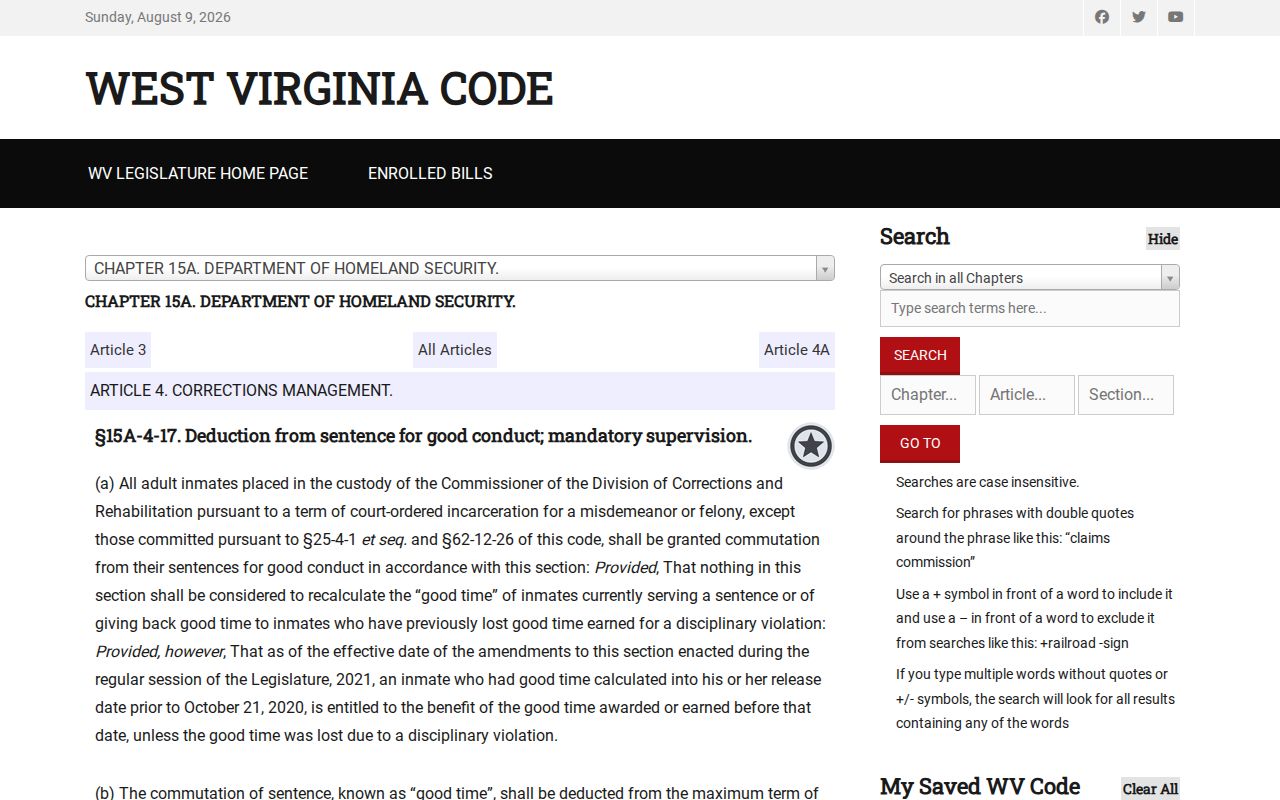
Use that statute with the person's live sentence data and DCR computation, since the general text cannot yield an individual date by itself.
Why Summers Is Not 85 Percent
No blanket West Virginia rule was found that requires every state prisoner to serve about 85 percent of a term. That shorthand is often tied to federal sentence rules and should not be imported into a Summers County case. West Virginia distinguishes one-for-one good time for eligible incarcerated days from PED, minimum discharge, and actual release.
It is also unsafe to promise that a person will serve half a sentence. Offense type, offense date, jail credit, consecutive or concurrent terms, discipline, extra credit, detainers, mandatory supervision, and later court orders can all matter. Section 62-12-13 supplies the parole eligibility framework, but special rules affect firearm cases, repeat-offender terms, life sentences, first-degree murder, and certain programs. Current amendments can be offense-date sensitive.
Is PED the date they leave? No. PED means eligibility for consideration. The West Virginia Parole Board can deny, defer, grant subject to conditions, or rescind a grant before release.
Note: DCR must compute the individual timesheet; a general fraction cannot replace the entered sentence, credit, and current agency record.
Summers Release Dates Can Change
A projected date is based on facts recorded at a point in time. If one input changes, DCR may revise the result. Some changes shorten the forecast, while others delay release or turn a planned community exit into a transfer. The agency record should identify the new calculation or movement; a public search result alone may not explain it.
| Factor | Effect on the date | Best source |
|---|---|---|
| Jail credit correction | Changes the time credited toward the term | Entered court order and DCR timesheet |
| Good-time loss or restoration | Moves the minimum-discharge computation | DCR computation and disciplinary record, as releasable |
| Amended or consecutive sentence | Changes the sentence structure used by DCR | Summers Circuit Court order |
| Detainer or another hold | May prevent return to the community at the scheduled exit | DCR release record and receiving agency |
| Parole grant, denial, or rescission | Changes the possible supervised-release route | Parole Board and DCR |
| New sentence or conditional-release change | Requires a new custody or supervision computation | Court and DCR Records |
A detainer is a request or process from another authority that can keep custody going after one case permits release. A DCR release to that authority is not community release. Ask for the exit type and public destination category.
Summers Parole Grant Release Lag
A Parole Board grant does not always lead to an immediate walk out of SRJCF. The Board's official FAQ says a person granted parole while at a regional jail must first transfer to a DCR facility for intake and fingerprinting. It advises allowing seven to ten days before actual release. Home-plan or other prerequisites may also remain.
This sequence matters for Summers County because SRJCF is the serving regional jail. A court or Board entry can mark legal progress while DCR still reports custody. Use the grant record to describe the decision. Use the DCR movement and release transaction to describe where and when the person actually went.
Region 4 Parole Services can help identify the supervising office after physical release, while the Board remains the source for its decision. A later supervision discharge is distinct from the original grant.
Request Summers Release-Date Records
When OIS does not show a clear projected date, ask WVDCR Records for a narrow set. Include the full name, known date of birth, OIS number, SRJCF or current institution, Summers County case number, and the sentence date. Request the public sentence-calculation sheet, minimum-discharge timesheet, PED field if maintained, and later release or movement transaction.
West Virginia FOIA requires a reasonably specific request. DCR Policy Directive 108.01 directs written requests to the Commissioner as records custodian at 1409 Greenbrier Street, Charleston, WV 25311. Ask for electronic copies where maintained and request redaction plus the reasonably segregable public remainder. Under section 29B-1-3, the agency must respond as soon as practicable and within five days excluding weekends and legal holidays by producing records, arranging inspection, or giving a written denial.
A public body may charge actual reproduction cost but may not treat staff search, retrieval, or man-hour reproduction time as reproduction cost. DCR's main records questions number is 304-558-2036. Protected medical, victim, security, personal, or other exempt content may be withheld.
Note: Ask for the code legend in effect on the transaction date if DCR supplies an abbreviation instead of a plain release type.
Confirm Summers Actual Release
A projected date becomes historical only after the responsible system records what happened. For a regional-jail episode, ask SRJCF or DCR for the release date, time, authority, exit type, and destination category. For a state prison sentence, use DCR's release or discharge record. For a federal sentence, the BOP locator has its own release date and status, which do not prove the end of all supervision or other custody.
West Virginia VINE can provide a status-change alert for DCR custody. Registration is useful for timely notice, but the service can lag and waits until arrival to report some transfers. A VINE alert should prompt a record check. The Summers County VINELink inmate search covers the specific-person registration steps.
Compare the DCR transaction with the Summers court order. The order explains legal authority, while the exit record supplies the physical custody timestamp. If the receiving agency differs, follow that agency next. This keeps a scheduled release, court-ordered release, transfer, and verified community exit from being mislabeled.