
Summers Federal Custody Connection
No federal prison was identified in Summers County. The local federal branch exists because WVDCR's FY2025 report says Southern Regional Jail and Correctional Facility contractually houses federal detainees for the U.S. Marshals Service. A person can sleep in a state-run building while remaining under federal authority. That fact does not turn a USMS detainee into a West Virginia state prisoner.
Identify the case and custodian before choosing a locator. A case in the U.S. District Court for the Southern District of West Virginia points to federal authority. A pretrial person is commonly managed by USMS and may be placed in a contract jail. After conviction and sentence, BOP designation makes the federal prison locator useful. The building name alone cannot show who controlled release.
Search Federal BOP Releases
The Federal Bureau of Prisons Inmate Locator covers federal incarceration records from 1982 forward. Search by register number in the displayed federal format when known. A name search can be narrowed using age, race, and sex. Compare all available identifiers before selecting a result, especially when names are common.
- Choose the number search when a BOP register number is available, or enter the complete name.
- Compare the returned register number and identity fields to the known federal case.
- Read the location and release-date fields exactly as displayed.
- Distinguish “Released” or “Not in BOP Custody” from release to the community.
- Check the federal docket and any receiving custodian when the route remains unclear.
BOP results can show name, register number, age, race, sex, release date, and location. “Released” or “Not in BOP Custody” means the person is no longer in BOP custody. Another government may hold the person, and a federal term of supervised release may follow imprisonment. BOP also warns that release dates can change during sentence recalculation.
View the official BOP locator screen before entering search details.
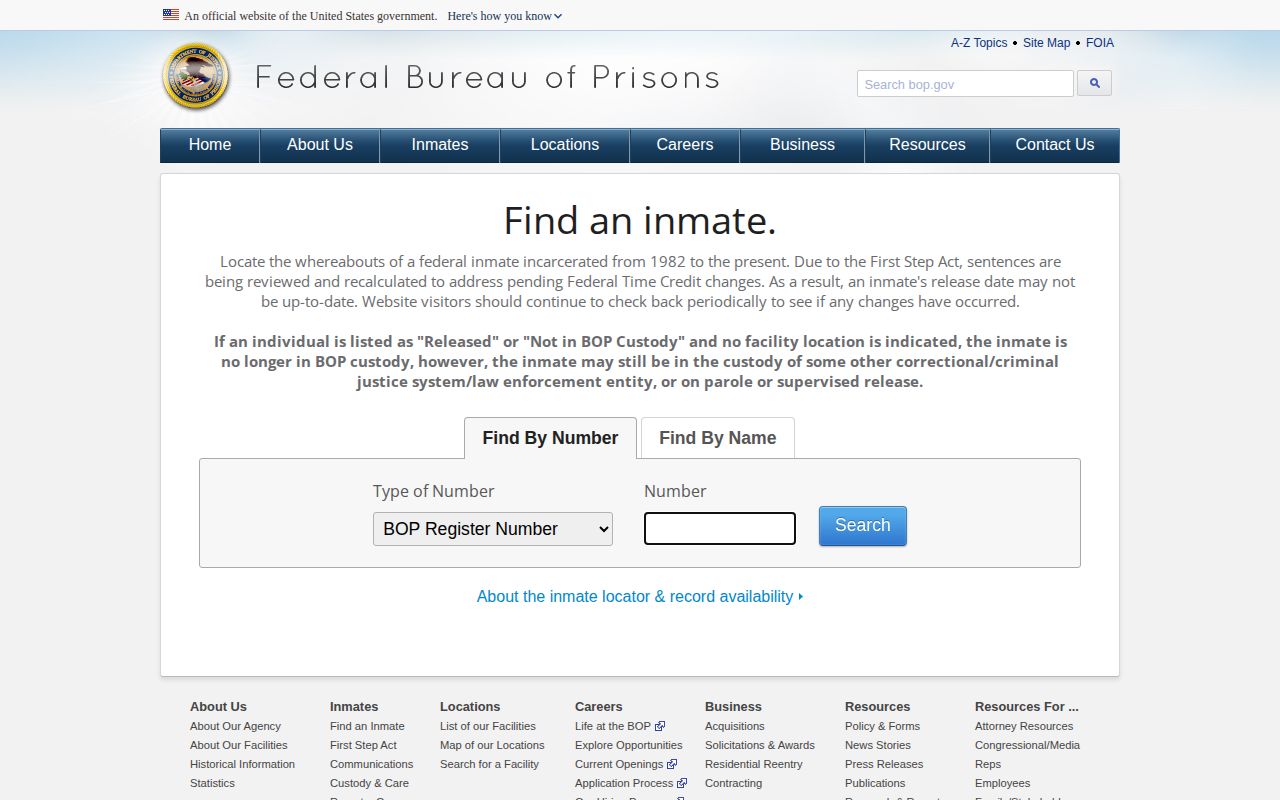
The captured locator shows the federal search route used for a sentenced BOP prisoner, not the separate route for a pretrial USMS detainee.
Read Federal Release Status
A BOP release date is evidence about BOP custody. It does not answer every question about the person's location or legal obligations. A move to a residential reentry center can remain BOP custody. A detainer handoff can end BOP custody while custody continues elsewhere. Supervised release is a federal court term served in the community after imprisonment, not the same as state parole.
| Locator or record | What it answers | What it does not prove |
|---|---|---|
| BOP active location | Reported BOP custody and facility | Final case outcome |
| BOP Released status | BOP custody has ended | Freedom from all custodians |
| Federal release order | Court authority and conditions | Exact processing time at a facility |
| USMS movement | Pretrial placement or transfer | A historical public release result |
A detainer is process asking that another authority receive or continue custody. When a federal result ends, check the destination in the formal record and search the relevant state or immigration custodian if the case facts support that step. State OIS, BOP, and ICE each report only their own scope.
Trace USMS Custody Releases
USMS has no public historical released-prisoner locator comparable to the BOP tool. This gap matters for SRJCF because the reported contract concerns USMS detainees. A federal pretrial person may disappear from West Virginia OIS after transfer to another contract site and still remain in federal custody. After sentencing, a transfer for BOP designation can create another system change.
Use the federal docket to find the detention, release, or sentencing order. The order gives legal authority and conditions, but facility processing or another hold may affect the actual departure. Contact the responsible district or USMS Prisoner Operations for the proper public inquiry route. Do not demand restricted movement details.
When a person once appeared at SRJCF, DCR may hold a facility movement record even though USMS controlled the detention decision. Compare that local movement evidence with the federal docket. A state-system disappearance should be described as a custody change until the responsible federal source confirms more.
Note: A USMS contract placement at SRJCF is federal pretrial custody, not a state sentence or a Summers County jail release.
Request Federal Release Records
For a former sentenced federal prisoner, use the locator first and then BOP FOIA for a more formal record. Describe the person and record narrowly. Useful identifiers include the full name, BOP register number, date of birth, known institution, federal case number, and date range. Privacy-protected content may require proof of identity, consent, or other authorization.
Ask for the public record that answers the actual question, such as the release date, location history, designation, or custody-status record. Do not ask an agency to create an analysis it does not maintain. If the issue concerns the court's legal authority, obtain the entered federal order rather than treating the locator as a court file.
- BOP register number
- The federal identifier used for a sentenced BOP prisoner.
- USMS detainee
- A person managed by the Marshals Service, often before trial or during transport.
- Supervised release
- Community supervision imposed by a federal court after imprisonment.
- Residential reentry center
- A community-based placement that may still count as BOP custody.
The Summers County release-record path can help when the record begins with an SRJCF result but the governing authority is not yet clear.
Federal Custody Contact Routes
A systemwide federal page has no single local facility address because no BOP prison was identified in Summers County. Use BOP's official locator and contact pages for sentenced people. Use the responsible USMS district and the federal court docket for pretrial custody. If SRJCF handled the physical placement, its operational line may confirm limited current information, while federal authorities remain responsible for the detention or release decision.
1200 Airport Road
Beaver, WV 25813
304-256-6726
Contract-site operational questions
Do not send federal release requests to the Summers County Sheriff merely because the person has a county connection. The Sheriff does not control BOP or USMS records. Likewise, WVDCR may document physical movement at SRJCF without holding the federal court's controlling release decision.
Federal and State Release Records
West Virginia DCR and federal agencies can appear in the same custody story. A state OIS record may identify SRJCF as the physical site. A federal docket may identify USMS as the authority. Later, BOP may report a designated prison and release date. Each source should be used for the segment it controls.
For a Summers County state case, use Regional Jail OIS or Prison OIS, the Summers court order, and DCR records. For a federal pretrial case, use the federal docket and USMS. For a sentenced federal case, use BOP plus the federal docket. If an immigration handoff is supported by case facts, use the ICE locator as a separate conditional check.
A disappearance from one search should prompt the next source, not a claim of freedom. Keep the search time, exact status text, case number, and agency response. That record trail makes later changes easier to explain.
Federal Release Lookup Limits
The BOP locator begins with records from 1982 forward, so it is not a complete archive for earlier federal confinement. Search results may also change when sentence computations change. No BOP result does not establish that a pretrial USMS detainee was released, since that person may never have entered the public BOP population.
Another limit is custody scope. “Not in BOP Custody” is literal. It does not resolve a state warrant, an immigration handoff, a contract placement still managed by USMS, or federal supervision in the community. Use restrained language and verify with the agency that created the relevant record.
For an older release, keep the locator result with the entered judgment and any formal BOP response. The judgment states the sentence and supervised-release term. The BOP record addresses custody computation and departure. Together they are more useful than a stale state-jail result from an earlier contract placement.
Note: The federal case number and controlling agency are stronger route markers than the county connection or the name of a contract building.