
Summers Parole and Probation Compared
Parole and probation can both place a person in the community under rules, but they begin in different ways. The West Virginia Parole Board decides whether an eligible incarcerated person may serve the rest of a sentence outside a facility. West Virginia Division of Corrections and Rehabilitation Parole Services then provides supervision. A Summers County judge imposes probation through the Thirtieth Judicial Circuit. Someone may receive probation without serving a prison term first.
Bond or pretrial release is another category. It allows a person to leave custody while a charge is pending, subject to the court's order, but it is not parole or probation. The Summers County sentencing order is the sound source for probation. The Board decision, DCR record, and Parole Services contact form the parole chain. A live jail roster cannot settle either question after the person leaves Southern Regional Jail and Correctional Facility.
| Point | Parole | Probation |
|---|---|---|
| Who imposes it | West Virginia Parole Board grants release under set terms | Summers County court imposes it by order |
| Who supervises | WVDCR Parole Services | Judicial probation in the Thirtieth Circuit |
| Best record | Board decision, DCR supervision record, later discharge | Entered sentencing or probation order and later court entries |
| How it ends | Authorized discharge after the required process | Completion or discharge shown in the court record |
- Parole
- Conditional community release while a prison sentence continues.
- Probation
- A court-ordered sentence or condition served in the community.
- Discharge
- The formal end of the sentence or supervision phase shown by the responsible authority.
- Absconder
- A person alleged to have stopped complying with supervision or whose location is unknown.
Verify Summers Post-Release Supervision
Start with the person's full name and DCR OIS number when known. The number helps prevent a same-name mix-up. For possible parole, review the Parole Board hearing calendar, then contact DCR Parole Services to identify the correct public route for current supervision. A calendar entry shows a hearing step. It does not prove a grant, physical release, or present reporting status.
For probation, locate the Summers County case. The free Magistrate Record Search can help with misdemeanor and early felony proceedings, while felony disposition documents come from the Circuit Clerk. Ask for the entered sentencing or probation order. Court staff can explain how to obtain a public file, but they do not replace its terms with an informal summary.
- Confirm identity with the full name, case number, and OIS number when available.
- Decide whether the likely status is parole, probation, bond, home confinement, or another court program.
- For parole, check official Board material and ask DCR Parole Services which Region 4 office has the assignment.
- For probation, obtain the entered order from the Summers Magistrate or Circuit Clerk and contact county probation for the proper office route.
- Ask for a discharge or completion record if the question is whether supervision has ended.
The Board holds monthly regional-jail hearings by video for eligible people, but no public individual-name decision database was found. Posted calendar material can help locate the month and hearing stage. A person-specific result should come from the notice, the Board, or a focused records request. Possible outcomes include grant, denial, postponement or further consideration, rescission before release, and revocation after release. Even a grant may leave a home plan or other condition incomplete.
Regional-jail parole has a special timing issue. The Board says a grantee at a regional jail must transfer to a DCR facility for intake and fingerprinting. Its FAQ advises anticipating seven to ten days before actual release. That means a Board grant for a person at SRJCF is not a gate timestamp. Compare the decision with DCR's later movement and exit record.
Note: A parole eligibility date only opens the door to consideration; it does not promise a hearing, grant, or release.
Summers Parole Region Four
DCR assigns Summers County to the Southern District's Region 4 with McDowell, Mercer, Monroe, and Wyoming Counties. The official directory expressly lists Summers under the Princeton office. It also lists the Welch office as serving Region 4. The directory does not assign each person to one building, so callers should not assume that the closest office has the file. Give an OIS number and ask which office handles the public verification request.
Princeton Parole Office
159 Davis Street
Princeton, WV 24739
304-425-7487
Summers County Probation
120 Ballengee Street, Suite 206
Hinton, WV 25951
304-466-7109 or 304-772-4057
Fax: 304-466-7132
These offices serve different systems. Princeton handles state parole assignments. Summers County Probation follows court-imposed probation. The official county courts page supplies the local judicial contacts and also lists other community-corrections programs.
Summers Supervision Beyond Parole
Summers County has a concrete local network for court control after jail release. The county lists Probation, Day Report, Home Confinement, and Drug Court in its Hinton courthouse and annex system. Day Report is in Suite 220 at 304-309-5504. Home Confinement uses the same suite and 304-309-5505. Drug Court is in Suite 219 at 304-466-8008. These programs can explain why someone is back in the community but still has court duties.
None of those offices is a public released-person locator. Their presence does not show that a named person participates. Read the controlling court order first, then contact the program listed in that order. A person who spent time at SRJCF does not become a parolee merely because a local program follows release. That distinction is central in Summers County because regional jail custody takes place in Beaver while court supervision is rooted in Hinton.
Note: Local program contact information helps route an inquiry, but the entered Summers County order establishes the form of court control.
Summers Supervision Violations and Warrants
Supervision conditions are the rules in the parole or probation record. A claimed violation can lead to agency review, a warrant, revocation proceedings, or a new custody episode. Revocation means the authority may cancel community supervision after the required process. A parole revocation comes through the state parole system. A probation violation returns to the court chain.
An absconder entry means the person is alleged to have stopped reporting or cannot be located. It does not erase the earlier release. No authoritative Summers County Sheriff absconder list was found, so third-party wanted pages should not be used. Check DCR's official offender-search gateway, contact Parole Services, and review the relevant court warrant record. Only the issuing body can say whether a warrant remains active.
The West Virginia State Police registry is a separate official source for people who have a statutory duty to register. It is not a list of all released people, parolees, probationers, or absconders.
The official registry screen shows the search tool used for that narrow registration question.
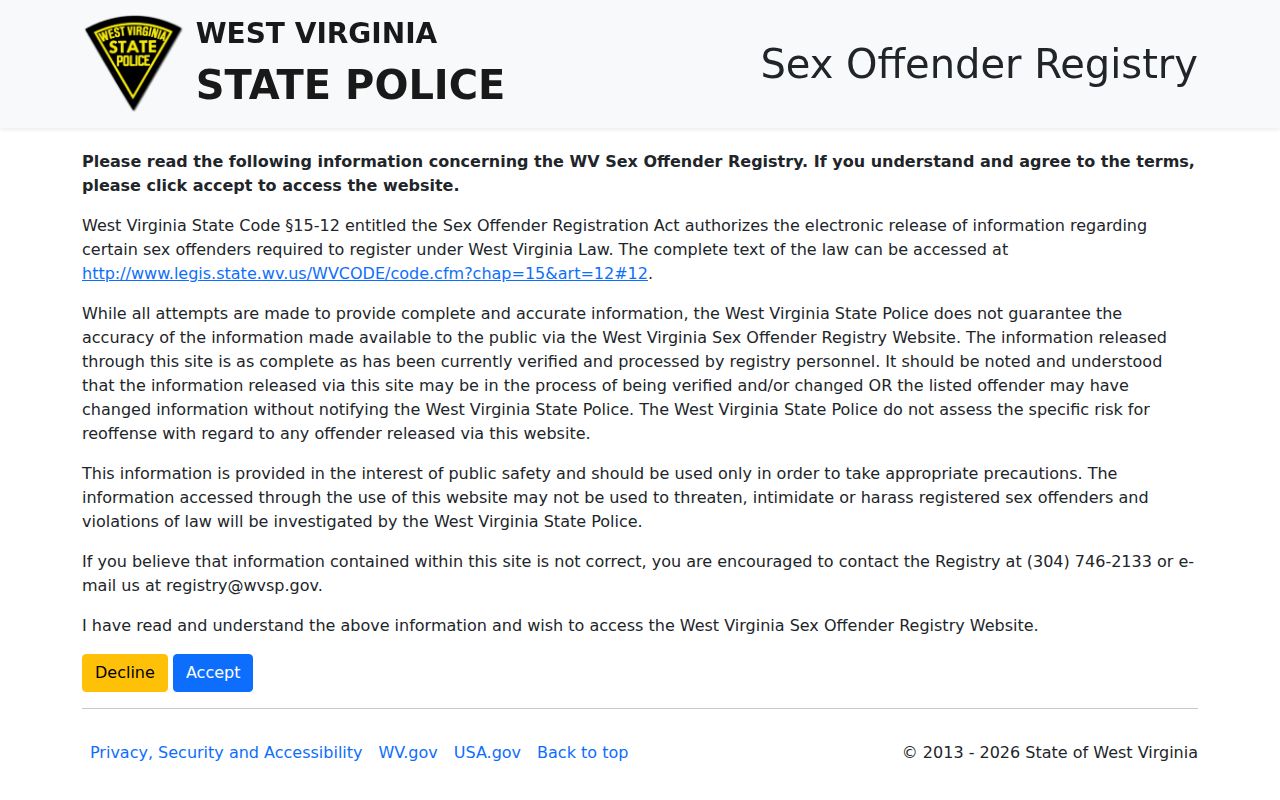
A registry result should be read only as registration information and not as proof of a release date, supervision type, or current risk.
Summers Release Property Pickup
Post-release needs can continue while parole or probation begins. WVDCR policy warns that personal property left after release may be disposed of after 30 days. The property policy also describes identification and a receipt for an authorized pickup. A released person or approved representative should contact Southern Regional Jail and Correctional Facility promptly and ask for the current process.
The policy does not state a release-door location, and facility steps may change. Call SRJCF at 304-256-6726 before travel. This practical task is separate from supervision verification. The property record shows what the facility held, while a Board, DCR, or court record shows the legal status after release.
Summers Supervision Discharge Records
Supervision ends through a formal action, not just the passage of time or the loss of a public search result. The Parole Board says a parolee can be considered for discharge after one successful year, or after five years for a life sentence, but the outcome is not automatic. It awaits the supervising officer's report and the required decision. Ask the Board or DCR for the public decision, certificate, or discharge record that answers the question.
For probation, use the Summers County court file. A completion or discharge entry must be tied to the correct case and order. Another open case, warrant, registration duty, or jurisdiction may still exist. Keep those matters separate from the supervision term being checked. The full release and custody-confirmation path is available on the Summers County released inmates search.
A request to the Parole Board may seek a decision concerning grant, denial, rescission, revocation, release, or discharge. Protected victim, treatment, psychological, and other exempt material may be withheld. Ask for redaction and the public remainder rather than demanding a full supervision file.
Ordinary VINE registration does not replace formal statutory victim notice. Under West Virginia Code section 62-12-23d, a qualifying written request goes to DCR and a separate request goes to the Parole Board. DCR states that a written request to it also registers the person in VINE, while the separate Board letter covers parole-hearing notice. Keep proof that each office received its own request.
Note: A final supervision record answers one agency's term; it does not prove that every case, warrant, or duty has ended.